

Chapter 13 Bankruptcy Budget Worksheet
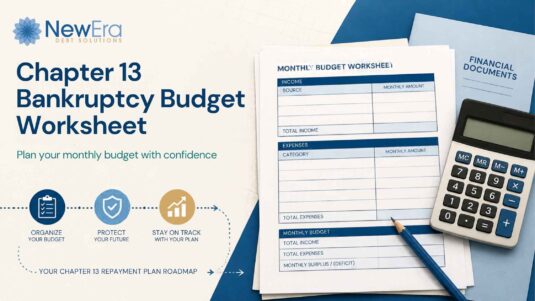
A Chapter 13 bankruptcy budget worksheet can help you turn a stressful financial picture into organized information. By listing income, household costs, debt payments, and irregular expenses, you can see which figures need attention before discussing a repayment plan. The worksheet is a preparation tool, not an official court form or a promise that a particular plan will be approved.
Review Chapter 13 bankruptcy basics
What is a Chapter 13 bankruptcy budget worksheet?
A budget worksheet is a structured record of money entering and leaving a household. A Chapter 13 version should make it easier to organize the information that may be relevant when you discuss income, necessary living costs, debts, property, and a proposed plan with a bankruptcy attorney. It can also help you identify records you still need to find.
There is no single personal worksheet that answers every question in every case. Official forms, supporting documents, court procedures, and legal requirements vary with the facts of a filing. A general worksheet should therefore be treated as a working draft. The Consumer.gov budget worksheet provides a general method for listing income and expenses, but it is not a Chapter 13 form and does not decide what a court will allow.
Chapter 13 is a court-supervised bankruptcy process built around a repayment plan. The way debts, income, property, and household obligations are treated depends on the individual case. If you need a broader introduction, read this plain-language guide to bankruptcy before using the worksheet to prepare questions.
Why prepare a budget before discussing a plan?
A recent bank balance rarely shows the full cost of maintaining a household. One paycheck may be higher because of overtime, while one month may be lower because an insurance bill or car repair has not arrived yet. Writing the numbers down over a representative period helps replace assumptions with a more useful picture.
- Test whether the budget is realistic. Compare dependable household income with ordinary living costs and other obligations instead of treating every remaining dollar as available for a plan.
- Find overlooked expenses. Registration fees, annual premiums, prescriptions, school costs, repairs, and seasonal bills can disappear when you estimate from memory.
- Separate facts from estimates. Mark an amount as estimated when you do not yet have a bill or enough records to confirm it.
- Prepare for a focused conversation. An organized worksheet lets you ask why a figure was used and what documentation supports it.
- Notice changes early. A job change, medical need, move, new dependent, or change in transportation costs can affect the household budget.
A worksheet does not establish eligibility, guarantee confirmation, determine the final payment, or predict how a case will end. Its value is that it gives you a more complete starting point for case-specific review.
What records should you gather first?
Begin with records rather than a blank page and memory. The exact documents required depend on your situation and the instructions from your attorney or court. Useful starting materials can include recent pay statements, benefit statements, bank statements, utility bills, rent or mortgage records, insurance notices, loan statements, medical receipts, child-care invoices, and receipts for purchases that do not occur monthly.
Choose a representative period. If income or spending changes from month to month, collect several months instead of selecting the most favorable month. Keep the original date and billing frequency for every entry. Then convert the figure to a monthly planning amount while preserving enough detail to explain how you reached it.
Income records
Gather pay statements and other records showing what the household actually receives. Note whether each amount is weekly, every two weeks, twice monthly, monthly, seasonal, temporary, or uncertain. A bonus, overtime shift, commission, or short-term contract should not automatically be treated as dependable income. At the same time, do not omit income simply because it varies. Label the variation and retain the records that show it.
It can be useful to keep both gross and take-home figures in your notes. Your worksheet may use net cash available for ordinary household planning, while official forms may request different information. Mixing the two without labels can make the result misleading.
Expense records
Collect current housing, utility, food, transportation, insurance, health care, child-care, education, and personal-needs information. Use bills where a bill exists. For spending that is not billed, review bank or card records and receipts across several weeks. If another person pays an expense or a household member contributes income, describe that arrangement accurately rather than silently adjusting the numbers.
Debt records
Make a separate entry for each creditor. Record the creditor name, approximate balance, regular payment, account status, and whether the debt is secured by property, when known. Keep statements available and flag balances you do not understand. Do not assume all debts have the same treatment in bankruptcy. This overview of what unsecured debt means may help with basic terminology, but it is not a case-specific legal analysis.
How do you fill out a Chapter 13 bankruptcy budget worksheet?
Work through the worksheet in a consistent order. The goal is not to make the result look favorable. The goal is to create a transparent record that can be checked against documents and updated when circumstances change.
- Set the time period. Use monthly figures for comparison, but write down whether each original amount was weekly, biweekly, quarterly, annual, or irregular.
- Enter dependable income. Start with the amount that reaches the household and retain gross-income details separately. For variable income, explain the period reviewed and the assumptions used.
- List housing and household necessities. Include rent or mortgage, required insurance, utilities, basic communications, and ordinary household supplies. Keep past-due amounts separate from recurring costs.
- Review food and personal needs. Use a spending review rather than an unusually low grocery week. Include necessary clothing, hygiene items, and other ordinary needs that apply to your household.
- Record transportation. Include vehicle payments, fuel, insurance, public transportation, parking, maintenance, and predictable repairs. A car repair that occurs twice a year still affects the annual budget.
- Add health and family obligations. Record premiums, prescriptions, co-pays, recurring treatment, child care, support obligations, and other necessary costs. Note amounts that are expected but not billed monthly.
- List debts account by account. Separate balances from monthly payments. Identify secured obligations and note accounts that are current, delinquent, disputed, or otherwise uncertain.
- Convert periodic costs. Divide a predictable annual cost by 12 for planning. An $840 annual insurance bill, for example, represents a $70 monthly planning amount, even though the insurer may bill you once a year.
- Calculate the preliminary remainder. Subtract the expenses you entered from the income you entered. Call the result an estimate, not an automatic plan payment.
- Check every line. Compare the worksheet with statements, mark estimates, find missing categories, date the document, and save the records supporting each significant figure.
Use a consistent method when converting income. If you are paid every two weeks, there are generally more than two paychecks in some months, so simply multiplying two checks by 12 may not describe annual cash flow accurately. Write down the method you used and ask how official documents should present the income.
Which budget categories deserve extra attention?
Some categories are easy to overlook because they are not the same every month. They deserve a second review before you rely on the remainder.
| Budget area | What to record | Review question |
|---|---|---|
| Income | Net pay, benefits, support, and other household receipts | Is the amount stable, seasonal, temporary, or uncertain? |
| Housing and utilities | Rent or mortgage, utilities, insurance, and required fees | Are current bills separated from past-due amounts? |
| Food and supplies | Groceries, household goods, and necessary personal items | Does the estimate reflect several weeks of ordinary spending? |
| Transportation | Payment, fuel, insurance, transit, parking, and repairs | What maintenance or registration costs occur during the year? |
| Health and care | Premiums, prescriptions, treatment, child care, and support needs | Are recurring and occasional costs both represented? |
| Debts | Creditor, balance, payment, status, and collateral if applicable | Are accounts listed separately rather than combined? |
| Irregular costs | Annual fees, taxes, school costs, repairs, and seasonal bills | What monthly reserve represents predictable yearly expenses? |
For a worked example, imagine a household with $5,200 in monthly take-home income. Its listed recurring costs total $4,450, leaving an apparent $750 remainder. Before treating that amount as available, the household should check whether it has included a $1,200 annual vehicle registration and repair estimate, a $600 annual insurance cost, and regular medical expenses. Those annual amounts alone add $150 per month to the planning picture. The revised remainder would be $600 before other case-specific questions are considered.
The example is only a budgeting illustration. It does not suggest that $600 is a Chapter 13 payment or that a court would use those exact categories. Its purpose is to show why a first subtraction can change when periodic costs are made visible.
How should you interpret the remaining amount?
If income exceeds the expenses you entered, review the difference instead of immediately assigning it to a plan. Ask whether taxes or insurance are paid outside payroll, whether a medical expense is missing, whether a vehicle will need work, and whether the income includes overtime that may not continue. Check whether a household member has an irregular expense that was not included.
If expenses exceed income, do not make the gap disappear by entering unrealistic amounts. First check for errors and duplicate entries. Then identify which costs are essential, which are flexible, and which are one-time events. A continuing shortfall may require a different conversation from a temporary shortfall caused by a single bill. Either way, an accurate worksheet is more useful than an artificially balanced one.
The worksheet remainder is not the same as disposable income for every legal purpose, and it is not a payment quote. Plan calculations can involve rules and facts that a simple household subtraction does not capture. Ask a qualified bankruptcy professional to explain how your figures relate to the official forms and proposed plan.
What mistakes should you avoid?
- Using gross and net income interchangeably. Label each figure and keep the underlying pay records so the difference is clear.
- Choosing one unusually good month. A high-overtime month or unusually low-spending month may not represent ordinary conditions.
- Leaving out nonmonthly expenses. Annual premiums, registration, repairs, school costs, and seasonal bills still affect the household over a full year.
- Counting uncertain income as guaranteed. Separate temporary overtime, bonuses, commissions, and irregular work from more dependable receipts.
- Combining every debt into one line. Separate accounts make it easier to identify balances, payments, collateral, and questions.
- Confusing past-due amounts with monthly costs. A catch-up amount may need a separate note rather than being added to a recurring bill without explanation.
- Ignoring cash and small purchases. Frequent small transactions can add up and may explain why a bank-balance estimate does not match actual spending.
- Making the worksheet fit a hoped-for answer. Do not reduce food, health, transportation, or household costs merely to create a desired remainder.
- Failing to update the document. Date each version and revise it when income, housing, health, family needs, or debt circumstances change.
- Assuming the worksheet decides legal treatment. It cannot determine eligibility, confirmation, discharge, or how a particular obligation will be handled.
Keep notes beside uncertain entries. For example, write “average of four months,” “annual bill divided by 12,” or “awaiting current statement.” This gives your attorney a clear reason for each estimate and makes later corrections easier.
How does a worksheet fit into the Chapter 13 process?
The worksheet is one preparation step among many. A bankruptcy professional may request documents and details that do not appear in a basic household budget. Official forms and local procedures also matter. Keep copies of the statements behind your entries, use consistent dates, and identify the assumptions that produced each estimate.
Before relying on a proposed payment, ask how it was calculated and which income, expenses, debts, and obligations were included. Ask what could cause the payment or budget to change. Ask how a job loss, major repair, illness, or other unexpected event should be handled. Do not assume that a plan can be changed informally; get case-specific guidance about the proper process.
If you are comparing bankruptcy with other ways to address unsecured debt, this guide to bankruptcy and debt settlement provides general context. You can also review possible benefits of debt settlement while remembering that an option must be evaluated against your own debts, income, assets, goals, and legal circumstances.
Someone who filed Chapter 7 recently may have additional timing and eligibility questions. The answer depends on the type and timing of earlier filings and other facts. This overview of Chapter 7 eligibility and process is background information, not a determination about your case.
What questions should you take to a professional?
A completed worksheet is most useful when it leads to specific questions. Consider asking:
- Which figures should be supported by statements, receipts, or other records?
- Should a particular income source be averaged, listed separately, or treated as uncertain?
- How should annual, seasonal, and irregular expenses be reported?
- Which debts should be listed separately, and what additional information is needed for secured obligations?
- What does the proposed payment include, and what does it not include?
- What events could require a review or change in the future?
- Which current official forms and local instructions apply to the filing?
Write down the answers and the date of the conversation. If the numbers change, preserve the earlier version rather than deleting it without explanation. A clear history can help show why an estimate was updated.
Frequently asked questions
Is there an official Chapter 13 bankruptcy budget worksheet?
A general household worksheet can organize your information, but it should not be confused with official bankruptcy forms or documents required in your case. Confirm current forms and supporting records with your attorney or appropriate court resources.
Can a worksheet tell me what my Chapter 13 payment will be?
No. Income minus expenses is only a preliminary budgeting calculation. Legal requirements, debt treatment, property, income history, and other case details may affect a plan. A qualified bankruptcy professional must review the full picture before you rely on a payment figure.
Should I include debt payments in my expense total?
Record each debt and payment in a clearly labeled section, but do not assume that every existing payment is treated alike in a plan budget. Keep the information transparent and ask your attorney how the debts should be reported and analyzed.
What if my income changes from month to month?
Gather records over a representative period, explain the method used to estimate monthly income, and identify seasonal or uncertain amounts. Do not choose only a high or low month to make the budget appear more favorable. Ask how the official forms should reflect the variation.
Can I prepare the worksheet without an attorney?
You can organize household figures yourself, and doing so may make a later discussion more productive. However, the worksheet cannot replace advice about eligibility, required forms, plan terms, or the treatment of particular debts. Discuss the records with a qualified professional before making decisions.
A careful next step
A useful Chapter 13 bankruptcy budget worksheet is realistic, organized, dated, and supported by records. It can help you identify missing expenses and prepare better questions, but it cannot promise eligibility, approval, a specific payment, or a particular outcome. If substantial unsecured debt is weighing on your household, compare possible paths carefully and seek guidance tailored to your circumstances.
Explore debt settlement as one possible option
Take time to verify each figure, keep the documents behind your estimates, and choose your next step only after you understand how it fits your financial and legal situation.
