
Debt Payoff Options for Large Balances
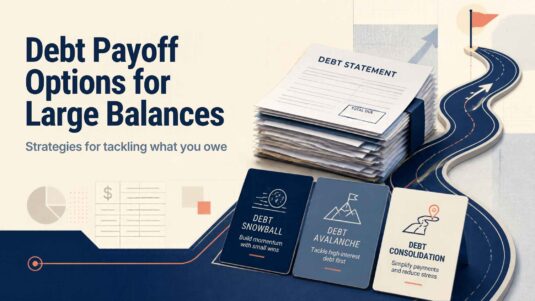
A large credit card balance does not get smaller just because the minimum payment clears. Debt payoff options for large balances split into two groups: plans that repay the full amount, and plans that resolve only part of it. The right group depends on whether you can still cover the full balance, not on which method sounds fastest.
Get a free debt analysis to see which option fits your accounts.
This guide scores six paths for unsecured balances that have already grown past a comfortable payoff. It does not promise a result. A specialist still has to look at your accounts, your state, and what you can set aside each month.
What Counts as a Large Balance
A balance is large when the minimum payment no longer moves the principal. Many adults reach that point around $10,000 or more in unsecured debt, with cards near their limits and at least one account already late. The dollar figure matters less than the math.
Interest is the first test. Credit card interest compounds on the unpaid balance, so a payment that only covers interest leaves the debt in place. If you want the mechanics, read how credit card interest compounds before you pick a plan.
The second test is cash flow. Add the minimums. Then add rent or a mortgage, food, utilities, a car payment, and a small emergency cushion. If the minimums consume what is left, a self-pay plan is already failing. How much credit card debt is too much walks through that pressure in more detail.
The third test is the type of debt. Credit cards, store cards, personal loans, and medical bills are unsecured. A mortgage and a car loan are secured. Federal student loans generally are not secured by collateral, but they have separate repayment and collection rules. Mixing debt types into one payoff plan can put a home or a car at risk. This article stays on consumer unsecured balances.
Six Debt Payoff Options for Large Balances
Each option below answers a different problem. Use the fit test, not the marketing name, to decide where to look first.
Keep paying on your own
Self-pay means you keep every account open and send more than the minimum. The avalanche method puts extra money on the highest interest rate. The snowball method puts it on the smallest balance. Both can work when the extra payment is real and steady.
They fail when the extra payment is a wish. A large balance at a high card rate can take many years of minimums, and one missed month adds fees that erase the progress. Self-pay fits when you are current, you have income you can count on, and you can pay more than the interest each month.
Ask the creditor for a hardship plan
A hardship program is a temporary deal with one creditor. The issuer may lower the rate, waive a fee, or set a fixed payment for a set number of months. You still repay what you owe. The account may be closed or restricted while the plan runs.
This path fits a short setback, such as a medical bill or a few months of reduced hours. It does not fit five or six maxed cards that you cannot repay in full. Compare the limits in credit card hardship programs versus debt settlement before you accept a plan that only covers one card.
Combine the balances into a new loan
A consolidation loan or a balance-transfer card replaces several payments with one. The Consumer Financial Protection Bureau notes that consolidation can lower a payment or a rate, but it does not erase the debt. You still owe the full amount, plus any fee or transfer cost.
Lenders price the new loan on credit and income. A reader who is already late, or whose cards are near the limit, may not qualify for a rate that beats the cards. A longer term can also raise the total interest even when the monthly bill drops. If a loan is realistic, start with how to consolidate credit card debt rather than treating this page as the application guide.
Use a credit counseling payment plan
Nonprofit credit counseling is education plus, sometimes, a debt management plan. You send one payment to the counseling agency. The agency pays your creditors. Counselors often ask creditors to lower the rate or waive late fees. They do not cut the principal, and they should not tell you to stop paying.
The Federal Trade Commission says a useful counselor spends time on your full budget and builds a plan you can keep. A promise of a quick fix, or a large fee before any work, is a warning sign. Counseling fits when you can repay the full balance over several years and you want one payment with a lower rate.
Settle unsecured accounts for less
Debt settlement is a negotiation. A creditor may accept less than the full balance as payment in full. You usually set money aside first, then a negotiator proposes a lump sum or a short series of payments. Federal rules bar a for-profit settlement company from collecting its fee before a settlement is reached, you approve it, and you make the first payment toward it.
NewEra Debt Solutions uses that performance-based model. The company is not paid until an account is settled and you make the first draft of that settlement. Fees are a percentage of enrolled debt, and some states cap that percentage. Across the industry, fees often fall around 15% to 25% of enrolled debt, but the exact figure depends on the company, the state, and the accounts. Do not treat any range as your quote.
Settlement is not a fit for every large balance. Creditors can refuse. They can also sue while you save. Forgiven debt over $600 can be taxable unless an exclusion such as insolvency applies. Credit scores often fall while accounts are delinquent, then can recover after the settlements are done. Read whether credit card debt can be settled and how long debt settlement takes before you enroll anywhere.
Consider bankruptcy only with a lawyer
Bankruptcy is a court process, not a payment trick. Chapter 7 may discharge some unsecured debt if you pass the means test. Chapter 13 is a court-supervised repayment plan, often three to five years. Both have filing costs, attorney fees, and public records. Some debts, including many taxes and recent domestic support, do not go away.
Bankruptcy can protect a home or wages when a lawsuit or garnishment is close. It can also be the wrong tool if most of the debt is secured, or if you can resolve the unsecured portion another way. This page does not tell you to file. A bankruptcy attorney in your state has to review eligibility.
Compare the Options Side by Side
Use this table as a first sort. It is not a quote, and it is not legal advice. Your rate, your timeline, and your fee depend on the creditor and your state.
| Option. | What you repay. | Best fit. | Main risk. |
|---|---|---|---|
| Self-pay. | Full balance plus interest. | Current accounts and real extra cash. | Interest outruns small extra payments. |
| Hardship plan. | Full balance, often at a lower rate. | One or two creditors and a short setback. | It does not fix a stack of maxed cards. |
| Consolidation loan. | Full balance on a new loan. | Fair credit and a lower rate you can qualify for. | Fees, a longer term, or a denial. |
| Credit counseling. | Full balance, often at reduced interest. | Steady income and a multi-year payoff. | Accounts may close, and fees still apply. |
| Debt settlement. | A negotiated portion, plus a fee after settlement. | Hardship and unsecured debt you cannot repay in full. | Lawsuits, credit damage, and possible tax on forgiven debt. |
| Bankruptcy. | What the court plan requires, or a discharge. | No realistic way to repay, or active legal pressure. | Cost, a public record, and debts that survive. |
If you are choosing only between a loan and a settlement, the longer comparison is debt settlement versus debt consolidation. If the choice is a counseling plan versus a negotiation, read debt settlement versus debt management.
How to Choose When the Balance Is Already Behind
Start with four facts, not with a company name. Write them down before you call anyone.
- List each unsecured balance, the interest rate, and whether the account is current, late, or in collections.
- Write the monthly amount you can set aside after housing, food, a car, and a small cushion.
- Mark any lawsuit, garnishment notice, or secured debt you must keep paying.
- Check whether a lender would still approve a consolidation loan at a rate below your cards.
Then use this order:
- If you are current and the extra payment beats the interest, stay with self-pay or a hardship plan.
- If you can repay the full balance over a few years, compare a loan with credit counseling.
- If you cannot repay the full balance, and the debt is unsecured, settlement is the option to evaluate next.
- If a creditor is already in court, or repayment is impossible, talk with a bankruptcy attorney before you enroll in anything.
Stopping payment is not a casual first step. The CFPB warns that settlement programs often involve falling behind, which can add fees and collection pressure, and that some creditors will not deal. Do not stop paying because a webpage said to. Confirm the plan, the account list, and the monthly deposit with a person who can see your bills.
Also separate marketing from the contract. The FTC says debt does not usually disappear on its own. And a company that asks for a large fee before any settlement is a reason to walk away. Money set aside for settlement should stay in an account you control.
What a Large-Balance Plan Does Not Fix
No payoff option repairs a budget that still spends more than it brings in. A settlement, a loan, or a court discharge can shrink the old balance. New charges on the same cards can rebuild it. Close or lock the cards you enroll, and keep one small card only if you can pay it in full.
A plan also does not protect a house or a car by itself. Secured lenders can still enforce their collateral if you miss those payments. Homeowners who need to separate the mortgage from card debt should read debt relief options for homeowners instead of folding the mortgage into this decision.
Credit scores move on their own timeline. A paid-in-full plan can be gentler on a report than a settlement or a bankruptcy. A settlement can still be the lower total cost when the alternative is years of interest you cannot pay. How debt settlement affects a credit score explains that tradeoff without treating a score change as guaranteed.
Finally, a plan does not replace a tax review. Forgiven debt can be income. Insolvency, where your debts exceed your assets, may exclude some or all of that income. A tax professional has to confirm that. Do not assume a settlement is tax-free.
A Worked Example, Not a Promise
Picture $28,000 across four credit cards, with two accounts already 60 days late. Minimums total about $780. After rent, food, a car, and a small cushion, the household can set aside $420. Self-pay is already short. A consolidation loan at a useful rate is unlikely while two cards are late.
A counseling plan might still work if creditors cut the rate enough to bring the full-balance payment near $420. And if the household can hold that payment for several years. If the payment stays near $780, the full-balance paths do not fit. Settlement is then the option to price. A monthly deposit near $420 is the starting figure. The timeline is often a couple of years. The fee comes only after each account settles and the first settlement payment is made.
That example is an illustration. Your creditors may want more. Your state may cap fees. Your income may change. The point is the sequence. Measure the gap between the minimums and the cash you have. Then pick the group of options that matches the gap.
Request a free debt analysis if you want those numbers checked against your own accounts, or reach the team on the contact page.
Frequently Asked Questions
What is the best debt payoff option for a large balance?
There is no single best option. If you can repay the full balance, self-pay, a hardship plan, a consolidation loan, or credit counseling are the first places to look. If you cannot, settlement or a lawyer’s review of bankruptcy may fit better. The cash you can set aside each month decides the group.
Can I pay off a large balance with minimum payments?
Sometimes, but it is slow, and interest can keep the balance from falling. If the minimum mostly covers interest, the balance is not on a real payoff path. A higher payment, a lower rate, or a different option is needed.
Does debt settlement erase a large balance?
No. A creditor may agree to accept less than the full balance, and you still pay that agreed amount plus any fee that applies after the settlement. Some accounts may not settle. Forgiven amounts can also create a tax form.
Will a consolidation loan help if my credit is already damaged?
Maybe not. Lenders look at credit and income. A denial, a high rate, or a long term can make the loan worse than the cards. Get a real offer before you treat a loan as the plan.
Should I stop paying my cards before I choose a plan?
No. Stopping payment can add fees and collection pressure, and it can lead to a lawsuit. Talk with a counselor, a settlement specialist, or a bankruptcy attorney first, and keep paying secured debts such as a car or a mortgage.
